This essay reflects on uncertainty—not as an obstacle to be reduced, but as a fertile space for life and creation.
It is precisely in that place—where certainties dissolve and the unexpected gains meaning—that the true essence of human existence unfolds.

Introduction text
Feeling the wind beneath its wings,
the dove longed to free itself
from all resistance.
It rose higher and higher,
where the air seemed still—
but then, to its surprise,
it began to fall.
Only then did it understand
that the wind—what it had resisted—
was what had sustained it all along.
Natalie’s voice-over will serve as the thread that gives shape and meaning to the work.
The presence of Albert Camus and the protagonist of The Stranger is felt throughout, reflected in the imagined dialogue Natalie sustains with her own projection of Meursault.
This dialogue unfolds as both an inner monologue and a third-person narration.

“I have always thought that the most important conversations do not take place in reality, but in that ambiguous territory between dream and wakefulness, between the present and memory.
This time, without realizing it, I had begun speaking with Meursault.
The protagonist of The Stranger had remained in my memory ever since I first read Albert Camus.
I do not know whether he arrived… or whether I summoned him. But there he was.
And he was willing to help me in my search.”
Dialogue between Natalie y Meursault

“Today the sea was almost still. Or so it seemed. I have always distrusted things that appear still.
He believes the wave is just a wave. That there is nothing more.
I like it when he simplifies things. But he is wrong.
The wave does not begin in the water. It begins earlier. In something we do not see: the wind.
The wind has no form. But it insists. And in insisting… it draws.
It draws a wave.
It draws a flag.
Like a child running for no reason.”
Each chapter opens with a symbolic narrative that builds a bridge toward the theme to be explored.
CHATTERTON — Introduction to “In search of authenticity”
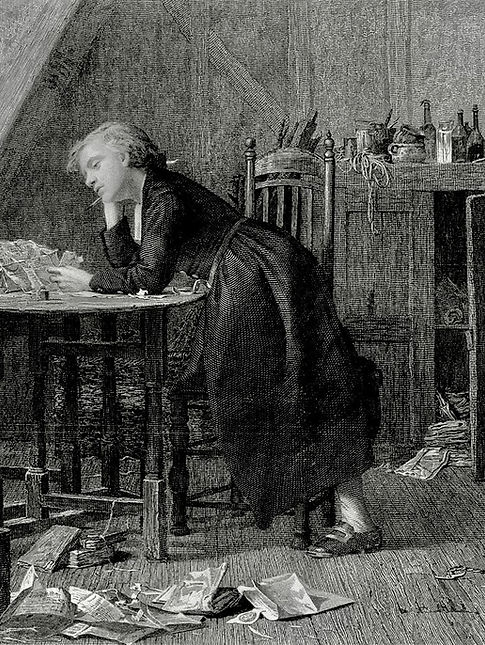
"Thomas Chatterton—or some version of him—appeared in a neighborhood in Tokyo. He walked along narrow streets, and I followed. He could not have been the young poet who took his own life at seventeen, and yet there he was.
He stopped in front of a shop and went inside; I followed.
He bent over a table where an ancient parchment lay. He picked it up and said, without looking at me:
“It’s a forgery.”
“How do you know?” I asked.
Wasn’t he, Chatterton, a master of forgery? He had invented medieval poems, only to die later in poverty. And yet there he was, holding that impossible parchment.
“I know because I wrote it,” he replied.
Everything seemed to defy reality. Japan, with its markets of objects that imitate antiquity, was the perfect setting to erase boundaries: the true and the false, indistinguishable.
“Japan is like any other place,” he told me. “It is full of truths that do not exist and lies that resonate more than reality. Original and copy are the same coin. And you, like everyone else, have spent years trying to tell them apart.”
I looked at him in silence; the parchment seemed on the verge of crumbling. Before I could ask anything, Chatterton stepped outside. I followed, but when I emerged, the street was empty: no trace of him, nor of the shop.
The question remained suspended: what is real and what is false? At what point does life become a story we invent to survive?
He never appeared again, but sometimes I remember that parchment and wonder whether what we live is, at its core, a carefully constructed forgery—a copy of a copy, waiting to be declared authentic."